Serving Tampa Bay, Florida
Tree Removal Services Across Tampa Bay, FL
Hazardous, fallen and storm-damaged trees rarely wait for a convenient moment. Fast Tree Removal handles removals, trimming, stump grinding and debris cleanup for homes, rentals and commercial properties throughout the Tampa Bay area — from a single leaning oak over a driveway to a full lot that needs clearing.
- Emergency, storm-damage and hazardous tree work
- Residential and commercial properties
- Crane-assisted access for tight lots
- Stump grinding and debris hauling
Prefer to write it out? Email [email protected] with your address and a short description.

Removals, trimming, stump grinding, land clearing and storm debris cleanup across the Tampa Bay region.
Know what you are looking at
Signs a Tree May Need Attention Sooner Rather Than Later
Most trees give some warning before they fail. The signs below are the ones worth acting on rather than watching — especially after a windy week, a heavy rain period or a named storm.

- A new or increasing leanA tree tilting toward a house, driveway, fence or a neighbor’s property matters most when the lean is recent. Cracked soil or lifted turf on the opposite side of the trunk suggests the root plate is shifting.
- Split trunks or major cracksA vertical seam, a separated fork or a crack that runs deep into the wood means the trunk is no longer carrying load the way it was designed to.
- Hanging or broken limbsA branch that has broken but stayed caught in the canopy can drop without warning. Keep the area beneath it clear until it has been brought down properly.
- Uprooted or exposed rootsRoots pushing up out of the ground, or a visible gap where the root ball meets the soil, points to a stability problem that pruning will not correct.
- Wind and storm damageTorn bark, stripped canopy sections and limbs bent against the trunk are common after strong gusts and often leave weight distributed unevenly.
- A fallen tree blocking accessTrees down across a driveway, walkway, gate or access road need to be cut and cleared in sections so the load releases in a controlled way.
- Dead trees and large dead branchesBare limbs while the rest of the canopy leafs out, peeling bark and fungal growth at the base all suggest decline. Dead wood becomes brittle and unpredictable.
- Heavy branches over roofs and vehiclesLimbs extending above a roofline, a parked car, a pool cage or a patio deserve a closer look before the next storm rather than after it.
Trees touching or near power lines
Do not touch the tree, the line or anything in contact with either — including fences and standing water nearby. Keep everyone well back and contact your utility provider, or emergency services if there is an immediate danger to people. Utility crews handle the line first; tree work follows once the area has been made safe.
What we do
Tree Removal and Tree Care Services
Twelve service paths covering everything from an urgent removal after a storm to routine trimming and lot clearing. Not sure which one applies? The selection guide further down matches common situations to the right service.

Service 01
Emergency Tree Removal
For trees that pose an immediate danger — resting on a structure, blocking an exit or holding weight that could shift. Work is scoped around making the area safe first.
Explore emergency tree removalStorm Damage Tree Removal
Cleanup after wind events: snapped tops, half-fallen trunks, limbs hung up in the canopy and trees leaning into a structure once the ground has softened.
Get help with storm-damaged treesTree Removal
Planned removal of unwanted, declining or badly placed trees, sectioned down in a controlled sequence to protect what is around them.
See how tree removal worksFallen Tree Removal
Trees already on the ground, across a fence or resting on a roofline. Cut-up and extraction is planned around tension in the trunk and whatever it landed on.
Arrange fallen tree removalTree Trimming and Pruning
Canopy reduction, deadwood removal and clearance work for limbs crowding roofs, driveways, fences and walkways on otherwise healthy trees.
Review tree trimming optionsStump Grinding and Removal
Grinding stumps below grade so the area can be re-turfed, replanted or paved, with grindings either removed or left to backfill the hole.
Look into stump grindingHazardous Tree Removal
Dead, decayed or structurally unsound trees taken down in stages, often without climbing, when the wood can no longer be trusted to hold a climber’s weight.
Understand hazardous tree removalCommercial Tree Removal
Work scheduled around tenants, customers and traffic flow at retail centers, offices, apartment communities and managed properties.
See commercial tree removalPalm Tree Removal
Removal of overgrown, storm-battered or unwanted palms, including tall specimens close to roofs, screen enclosures and property lines.
Explore palm tree removalCrane-Assisted Tree Removal
Lifting heavy sections out over a roof, pool or fence line when there is no safe drop zone and dragging material through the yard is not an option.
Learn about crane-assisted removalLand Clearing
Clearing trees, brush and undergrowth from lots, building sites and overgrown parcels so the ground can be surveyed, fenced or developed.
Discuss land and lot clearingTree Debris Removal
Hauling away branches, logs and storm-scattered material left behind on a property, whether or not we did the cutting.
Schedule tree debris cleanupLocal conditions
Why Tree Decisions Look Different Around Tampa Bay
Trees here grow fast, hold a full canopy most of the year and sit in sandy soil that behaves very differently wet than dry. That combination shapes almost every removal and trimming decision made on a property in this region.
During hurricane season, sustained wind arrives after days of rain have already saturated the ground. A tree that looked solid in April can shift in August simply because the soil no longer grips the root plate the way it did. That is why a lean that appears after a storm is treated differently from one a tree has held for twenty years.
Lot layouts add another layer. Many neighborhoods place mature oaks, pines and palms within a few feet of a roof, a pool cage, a fence line or a shared property boundary. There is often no clear drop zone, so sections have to be roped down piece by piece — or lifted out entirely.

Wind and saturated ground
Heavy rain softens the soil, and wind does the rest. Root plates lift, trunks tilt and trees that were stable a week earlier start moving. Cracked soil near the base is worth reporting when you call.
Palms need their own approach
Palms fail differently from hardwoods. Old fronds, seed pods and heavy crowns come down in sections, and tall specimens near a screen enclosure or pool deck usually need to be lowered rather than dropped.
Tight properties, limited access
Narrow side yards, low gates and fenced pool areas restrict what equipment can reach a tree. Access is assessed before the work is planned, because it often decides whether a crane makes sense.
Debris outlasts the storm
After a wind event, the trees are only part of the job. Snapped limbs, palm fronds and stacked brush left along a driveway or fence line frequently need a separate cleanup pass.
Who we work with
Residential and Commercial Tree Solutions
A backyard oak and a tree overhanging a shopping center parking row need the same care but a very different plan. Access, timing, equipment and debris handling all shift with the property type.

Homes and rentals
Residential properties
Homes, rental properties and townhomes where the tree in question is usually within a few feet of something that matters. The plan tends to be built around what sits underneath.
- Limbs overhanging roofs, gutters and skylights
- Trees crowding driveways, gates and parked vehicles
- Backyard removals with only a side-yard route out
- Work near fences, pools, screen enclosures and patios
- Outdoor living areas that need protection during the job
- Rental and vacation properties handled remotely by owners
Where the drop zone is tight, sections are lowered on ropes or lifted clear rather than felled. Ground protection and rigging decisions are made before a saw starts.

Managed and commercial sites
Commercial and managed properties
Retail centers, offices, apartment communities, HOA common areas, development sites and vacant lots — where coordination usually matters as much as the cutting itself.
- Parking areas and access roads that must stay usable
- Tenant, resident and customer traffic during work hours
- HOA common areas and shared boundary trees
- Property managers handling multiple sites at once
- Development parcels and overgrown vacant lots
- Storm cleanup spread across a whole community
Larger sites often need staged scheduling, defined drop zones, a debris staging area and a route heavy equipment can actually use without damaging pavement or irrigation.
What to expect
How the Tree Removal Process Works
Most projects move through a similar sequence, though the detail changes with the tree, the property and the urgency of the situation.

-
Describe the tree problem
Call or email with the property address, what the tree is doing and what sits near it. Photos taken from a safe distance help, but never put yourself under or beside an unstable tree to get one.
-
Evaluate the tree and its surroundings
The tree’s condition, the ground around it, nearby structures, overhead lines and the route in all get looked at together. Access frequently drives the plan more than the tree itself.
-
Recommend a service approach
Sometimes full removal is the answer; sometimes reduction or deadwood removal resolves it. You get a clear recommendation and the reasoning behind it before anything is scheduled.
-
Plan the work
Rigging points, cut sequence, drop zones, equipment placement and property protection are settled in advance, along with timing that suits residents, tenants or business hours.
-
Handle branches, logs and debris
Material is chipped, cut to a length you specify, stacked where you want it or hauled away — agreed ahead of time rather than decided at the end of the day.
-
Review the finished work area
We walk the site with you, confirm the agreed scope is complete and cover anything still outstanding, such as a stump to grind or a second tree to schedule.
Not every project follows all six steps in the same order. Emergency and storm work often compresses the early stages so the immediate hazard can be addressed first, with cleanup and stump work handled on a later visit.
Find the right service
Which Tree Service Fits Your Situation?
Use this as a starting point for the conversation, not a diagnosis. Tree stability cannot be judged from a web page — anything involving a lean, a crack or storm damage should be looked at on site.

Coverage
Tampa Bay Communities We Serve
Crews work across both sides of the bay and up into Pasco County. If your street is not listed below, call with the address — coverage extends past these communities.

St. Petersburg
Older neighborhoods with mature oaks close to homes, driveways and alley access.
Tree removal in St. PetersburgClearwater
Coastal wind exposure, palms and canopy trees over pools and screen enclosures.
Tree removal services in ClearwaterBrandon
Established subdivisions where large trees sit near fences and shared boundaries.
Explore tree removal in BrandonRiverview
Newer developments with fast-growing trees and tight side-yard access.
Tree removal help in RiverviewWesley Chapel
Wooded lot edges, preserve boundaries and pines that shed heavily in wind.
Tree removal in Wesley ChapelLand O’ Lakes
Larger parcels, lakeside lots and clearing work on partially wooded ground.
Tree services in Land O’ LakesCarrollwood
Dense canopy over established streets, driveways and rooflines.
Tree removal in CarrollwoodTown ‘n’ Country
Compact lots where removals often call for rigging rather than felling.
Tree removal in Town ‘n’ CountryValrico
Wide residential lots plus oaks and pines along property lines and pastures.
Tree removal help in ValricoLargo
Mixed residential and commercial sites with trees near parking and access routes.
Tree removal services in LargoApollo Beach
Waterfront exposure, salt-air stress on palms and wind-driven canopy damage.
Tree removal in Apollo BeachDunedin
Mature street trees and tight historic-district lots with restricted equipment access.
Explore tree removal in DunedinPalm Harbor
Heavily wooded neighborhoods with tall pines and oaks overhanging homes.
Tree removal help in Palm HarborNew Port Richey
Riverfront and low-lying properties where saturated ground affects tree stability.
Tree removal in New Port Richey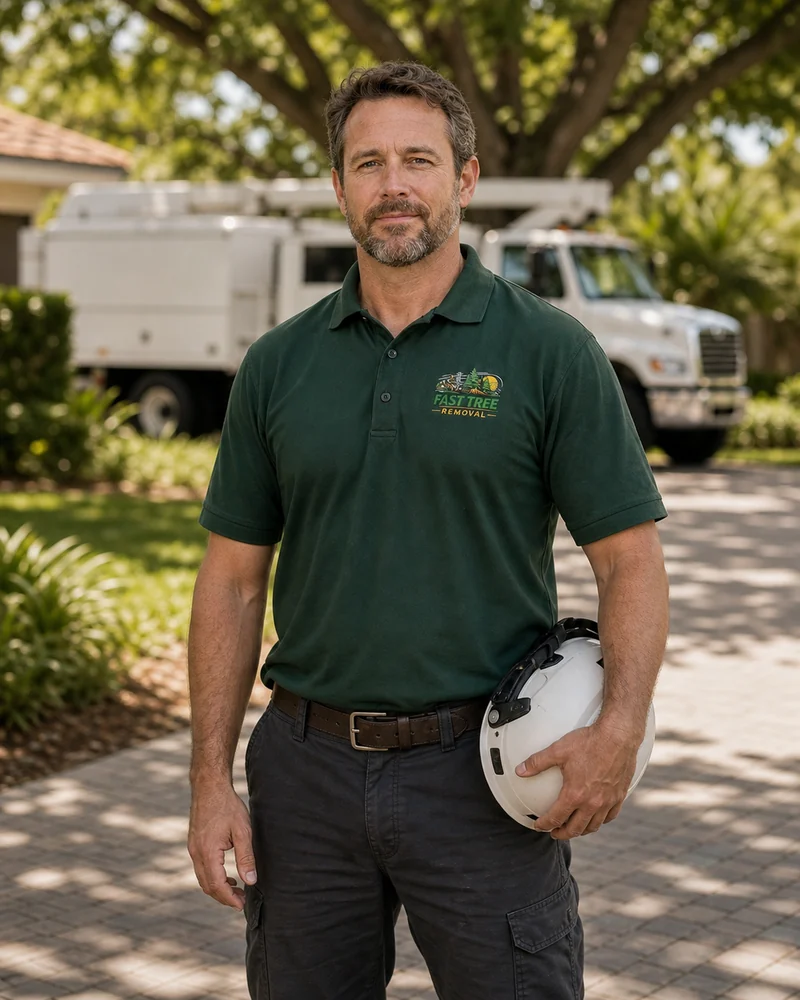
Owner & Service Oversight
Meet Michael Carter, Owner of Fast Tree Removal
Owner & ISA Certified Arborist
Fast Tree Removal — Serving Tampa Bay, FL
Michael Carter is the owner and ISA Certified Arborist behind Fast Tree Removal, working with homeowners, property managers and commercial properties across Tampa Bay. His role covers evaluating the visible condition of a tree, its position relative to nearby structures, and the access requirements that shape how the work is planned.
Tree concerns in this region tend to involve storm-damaged branches, leaning trees, palms close to roofs or pools, restricted residential access and debris blocking driveways or entrances. Michael’s service-oversight approach starts with the property conditions and your main concern, then works out whether removal, trimming, stump work or debris handling is the appropriate response — including saying so plainly when a smaller scope would do the job.
What Michael Considers Before Tree Work Is Planned
- Tree condition Visible leaning, cracking, dead limbs, storm damage or other concerns that may require an on-site evaluation.
- Nearby property features Homes, roofs, fences, pools, driveways, vehicles, walkways and frequently used areas around the tree.
- Tampa Bay site conditions Storm exposure, palms and subtropical vegetation, water-saturated ground and limited access between nearby properties.
- Work and cleanup requirements The possible removal or trimming approach, equipment access, branches, logs, stump needs and tree-debris handling.
Describe the tree, its location on the property and anything it is currently affecting.
How tree work is coordinated
A Coordinated Approach to Tree Work Around Your Property
Depending on the tree, the property access and the work required, a project may involve several things at once: checking the condition of the tree, working carefully around what stands nearby, and deciding what happens to the branches, logs and debris afterwards.
How that work is arranged is not fixed. A palm beside a pool cage, a storm-damaged limb hung up over a driveway and a large tree behind a fenced backyard each call for a different approach, so the plan is built around your property rather than a standard routine.
Before work is planned
What shapes the plan
-
Property access
Driveways, gates, side yards, structures and the available space around the tree.
-
Tree position
How the tree relates to roofs, fences, pools, walkways, vehicles and frequently used areas.
-
Work planning
The sequence, access needs and debris considerations that may influence the work approach.
These points are considered together, because access to a property often shapes the approach as much as the tree itself does.
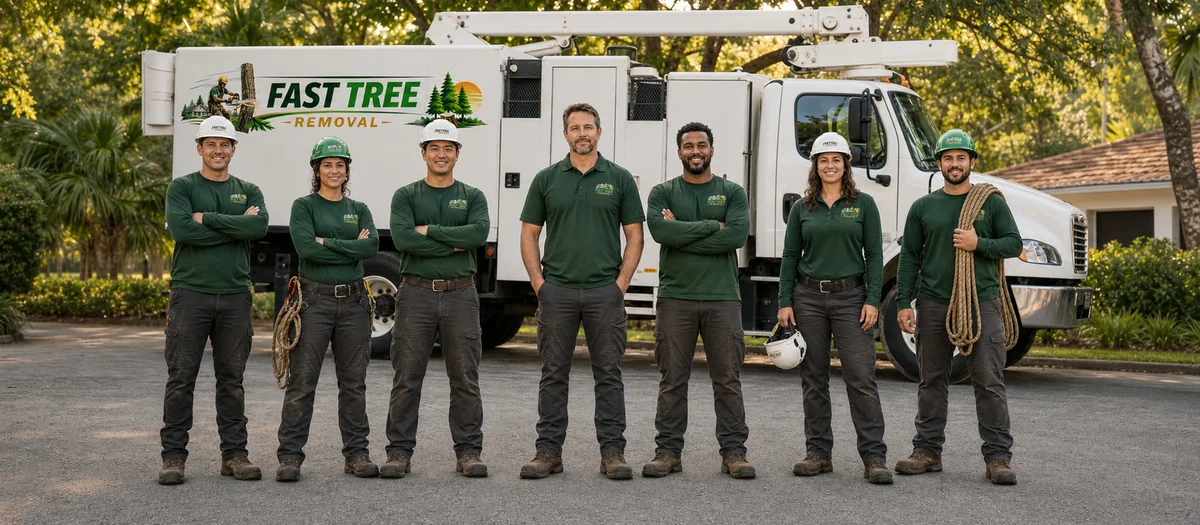
Property and access review
Where the tree stands, what sits beneath it, and how equipment and material could realistically reach it. Gate widths, side-yard clearance and the route in are looked at early, because access often shapes the approach more than the size of the tree does.
Tree-work coordination
Where appropriate, the order branches come off, how sections are lowered or lifted clear, and what equipment a project may require. The sequence is agreed before anything is cut, so you know how the work is expected to move around the property.
Ground-area awareness
Driveways, walkways, fences, pools, roofs, patios and parked vehicles are all noted before work begins, along with the entrances and parking areas a commercial property may need to keep usable while the work is under way.
Debris and completion planning
What happens to the branches and logs once a tree is down: which material leaves the property, what may be chipped or stacked instead, and whether stump grinding or a separate debris pickup is also worth arranging at the same time.
The approach can vary based on
- Tree condition
- Property access
- Nearby structures
- Service type
- Material handling needs
The work approach can vary considerably between a single backyard tree, a storm-damaged property and a managed commercial site. Describing the tree, what stands near it and how a vehicle would reach the area is usually enough to point to the right service.
Working with us
Why Property Owners Contact Fast Tree Removal
No sales pitch — just what you can actually expect when you get in touch about a tree.

One point of contact for the whole job
Removal, trimming, stump grinding and debris hauling are handled through the same conversation instead of three separate vendors.
Coverage across the region
Service reaches communities on both sides of the bay and into Pasco County, so one call works whether the property is in Dunedin or Riverview.
Homes and commercial sites alike
Single backyard trees and multi-property storm cleanups both get a plan built around access, timing and what needs to stay open.
Straightforward ways to reach us
Call +1 813-471-5719 to talk it through, or email [email protected] when you would rather send details and photos in writing.
Guidance before you commit
If trimming solves the problem, we will say so. The recommendation comes with the reasoning, not just a price for the biggest option.
Work scoped to the situation
Urgent hazards, planned removals and seasonal maintenance are each approached differently rather than pushed into one package.
After the wind stops
Storm and Emergency Readiness
The hours right after a wind event are when most avoidable injuries happen. A few simple rules keep you out of the way while the tree work gets sorted.

Stay safe first
- Keep people, pets and vehicles clear of any tree that has shifted, split or partially fallen.
- Never stand or walk beneath hanging limbs, even ones that appear wedged in place.
- Do not touch a tree, branch or fence in contact with a power line. Contact your utility provider, or emergency services if anyone is at risk.
- Leave the cutting to a crew. Fallen trunks and limbs hold tension that releases unpredictably under a saw.
- Photograph visible damage only from a safe position — never from under, beside or on top of a compromised tree.
What to tell us when you call
A clear description helps us bring the right equipment on the first trip:
- Whether the tree has fallen, split or started leaning
- What it is resting on — roof, fence, vehicle, pool cage or open ground
- Whether a driveway, road, roof or entrance is blocked
- Access limits: gate widths, low branches, soft ground or parked cars
Ask about storm damage tree removal, hazardous tree removal or debris cleanup when you call.
Questions we hear often
Frequently Asked Questions
Straight answers to the things Tampa Bay property owners ask before booking tree work.

When should a damaged tree be removed?
Removal is usually considered when the damage affects the tree’s structure rather than only its appearance. A split trunk, a large cavity, a broken main leader, torn roots or a heavy lean that appeared suddenly all point toward a tree that may not stabilize on its own. Damage limited to smaller outer branches can often be handled with trimming instead. Describe what you can see from a safe distance when you call and we can talk through which approach fits the tree.
Can a leaning tree be saved?
Sometimes. Trees that have grown at an angle over many years toward light or away from a structure are often stable. The concern is a lean that is new, that keeps increasing, or that comes with cracked soil, lifted turf or exposed roots on the opposite side — those signs suggest the root plate is moving. That situation is assessed on site, because a lean cannot be judged reliably from a description or a photo alone.
What should I do when a tree falls after a storm?
Keep people, pets and vehicles away from the tree and from anything it is resting on, including fences and roof edges. Do not climb on the trunk or cut limbs that are under tension. If the tree is touching a power line or a downed wire, stay well back and contact your utility provider or emergency services. Once the area is safe, call us and describe where the tree landed and what it is blocking so we can plan the removal.
When is crane-assisted tree removal needed?
A crane is generally used when large sections need to be lifted out rather than dropped or lowered by rope. That includes trees in tight backyards, trees over pools, roofs, screen enclosures or driveways, and trees too compromised to climb safely. It also shortens the time heavy weight spends moving over a property, which can reduce risk to what is underneath.
Is trimming an alternative to complete removal?
Often, yes. A healthy tree that has simply grown over a roof, into a driveway sightline or against a fence can usually be reduced and cleared with pruning rather than taken down. Trimming is not a substitute when the trunk, root system or main structure is compromised — in those cases reducing the canopy does not correct the underlying problem.
What happens to branches and tree debris?
How debris is handled is agreed before the work starts. Branches can be chipped on site, logs can be cut to a length you specify and left, or the material can be hauled away. Storm work often leaves debris from more than one tree, so we confirm what stays and what goes rather than assuming. Debris hauling is also available on its own when another crew or a storm has already left material behind.
Do you handle residential and commercial properties?
Yes. Residential work covers single-family homes, rental properties, backyards, driveways, fence lines and pool areas. Commercial work covers retail centers, offices, apartment communities, HOA common areas, managed properties, development sites, vacant lots, access roads and parking areas. Commercial projects usually involve extra coordination around traffic flow, tenant access and scheduling windows.
Which Tampa Bay areas are served?
Coverage includes St. Petersburg, Clearwater, Brandon, Riverview, Wesley Chapel, Land O’ Lakes, Carrollwood, Town ‘n’ Country, Valrico, Largo, Apollo Beach, Dunedin, Palm Harbor and New Port Richey, along with surrounding neighborhoods across the Tampa Bay region. Call +1 813-471-5719 with your address if you are unsure whether your street falls inside the service area.
Tampa Bay tree service
Talk to Us About Your Tree
Whether a storm has left a trunk across the driveway, an oak is leaning toward the roof or a lot needs clearing, describe the situation and we will tell you what the work involves. Serving property owners and managers throughout the Tampa Bay area.
Photos and the property address help us understand the job before we arrive.
